
The Pakistan Army's top commanders have decided to throw their weight behind the Supreme Court in its standoff with the civilian government over the memo scandal and the revival of high-profile graft cases, according to a media report on Friday.
Pakistan's powerful Army chief General Ashfaq Pervez Kayani told a top American diplomat that his establishment wanted the resumption of back channel talks with India, but President Asif Ali Zardari was against it, according to a secret United States cable leaked by WikiLeaks.
Pakistan Army Chief General Ashfaq Parvez Kayani has not ruled out the possibility of an American ground offensive in North Waziristan, but told parliamentarians at a briefing that Washington will have to think many times before launching such an attack.
Pakistan army chief General Ashfaq Parvez Kayani, under pressure from his colleagues to "reduce" ties with the United States following the unilateral American raid that killed Osama bin Laden, is said to be "fighting to survive".
In a major embarrassment for Pakistan's powerful army chief General Ashfaq Pervez Kayani, Al-Qaeda chief Osama Bin Laden was killed just yards from a military compound that he visited last month where he had famously claimed that his forces had broken the "terrorist backbone".
Amid speculation of a military takeover in Pakistan, its powerful army chief General Ashfaq Parvez Kayani has bluntly told the civilian leadership to put its house in order through measures like a crackdown on corruption and improvement in its "faltering" response to the devastating floods.
China vowed to take its military ties with Pakistan to a "new high" and defended its nuclear cooperation with Islamabad to build two new reactors for the country.
The Pakistan Army distanced itself from media reports that its chief General Ashfaq Parvez Kayani had arranged a secret meeting between Afghan President Hamid Karzai and the leader of the Haqqani militant network based in North Waziristan.
India's latest offer of talks has been taken up by Pakistan President Asif Ali Zardari, Prime Minister Yousuf Raza Gilani and army chief General Ashfaq Parvez Kayani.
India's latest offer of talks has been taken up by Pakistan President Asif Ali Zardari, Prime Minister Yousuf Raza Gilani and army chief General Ashfaq Parvez Kayani.
Pakistan's army chief General Ashfaq Parvez Kayani on Monday emphasised the need to avoid a conflict with India in the wake of the Mumbai attacks as China launched a diplomatic initiative to ease tensions by dispatching a top diplomat to Islamabad. Kayani's comments, believed to be his first on the situation, came during his talks with Chinese Vice Foreign Minister He Yafei, who is in Islamabad.
Top military commanders of Afghanistan, Pakistan and the North Atlantic Treaty Organisation on Sunday discussed border control measures and mechanisms to avert "untoward incidents" along the Afghan frontier, as the three sides resumed high-level military contact after a break of several months.
Refusing to play second fiddle to the powerful military, former Pakistan Prime Minister Nawaz Sharif has said he will be the Army chief's "boss" if voted back to power in the May 11 general elections.
Pakistan is abuzz with rumours that the country's all-powerful military may topple the fragile government in Islamabad within next 48 hours.
In a sensational claim, a former Pakistan army general has said that Osama bin Laden had been kept in a "safe house" of Intelligence Bureau in Abbottabad with "full knowledge" of the then ruler Pervez Musharraf and possibly current Army Chief General Ashfaq Pervez Kayani.
The Memogate scandal in Pakistan has taken a turn for the worse, with the central character in the controversy Manzoor Ijaz's refusal to appear before the judicial commission investigating the issue. Amir Mir reports from Islamabad.
US Secretary of State Hillary Clinton and Pakistani Foreign Minister Shah Mahmood Qureshi would co-chair the first US-Pak Strategic Dialogue to be held in Washington on March 24.
The elected government in Pakistan has found that the little control it had over the army has been completely eroded, says B Raman

'By beheading an Indian soldier, the Pakistan army has demonstrated its proclivity for barbaric medievalism.' 'The strategies adopted and the punishment inflicted by India must be made progressively more stringent with every new act of terrorism till the cost becomes prohibitive for Pakistan,' says Brigadier Gurmeet Kanwal (retd).
The Pentagon leadership has strongly denied reports that it has pressurised Pakistani army chief General Ashfaq Kayani to extend the military's anti-Taliban operations into North Waziristan, in the wake of the botched Times Square bombing attempt by Pakistani-American Faisal Shahzad, who received terror training in that region.
The 'trust deficit' between the United States and Pakistan has seemingly evaporated after the strategic dialogue between Washington and Islamabad in March, that also featured Army chief General Ashfaq Kayani and Inter Services Intelligence director general Shujat Ahmad Pasha.If the remarks of Daniel Benjamin, the State Department's coordinator for counter-terrorism are anything to go by, the US no longer is suspicious of Pakistan playing a double game.
The timing and mode of the attack in which two Indian soldiers were killed unambiguously point towards the complicity of the Pakistan military leadership in this misadventure. After all just a few months back Pakistan Army chief General Ashfaq Kayani was all for peace. The solution to this riddle lies in the political developments within Pakistan, says Alok Bansal
The US may re-look its human and technical intelligence apparatus in Pakistan following the attack on seven CIA officers in Khost and the failed New York bombing plot, writes security expert B Raman

Lt Gen Zubair Hayat appointed as Chairman of Joint Chief of Staff Committee.
Amid intense US pressure to deliver on the war on terror, the chief of Pakistan's powerful Inter Services Intelligence has been shunted out of Islamabad and replaced by Lieutenant General Ahmad Shuja Pasha, considered close to the reform-minded Army Chief Ashfaq Parvez Kayani.
According to sources, this decision was taken during a high-level informal meeting held at the Presidency, which was chaired by President Asif Ali Zardari and attended by Prime Minister Raja Pervez Ashraf, Army Chief General Ashfaq Pervez Kayani, ISI DG Lt. Gen Zaheerul Islam, foreign secretary and Pakistan's ambassador to US Sherry Rehman, reports The Nation.
The appointment of General Raheel Sharif as the new army chief of Pakistan has come as a surprise to many. Rajiv Dogra, former ambassador and India's last Consul General to Karachi, speaks to Aabhas Sharma about the appointment, what it says about the priorities of Pakistan Prime Minister Nawaz Sharif and most importantly, what it means for India.
Pakistan is expected to reopen the North Atlantic Treaty Organisation supply line anytime now, as the United States has agreed to tender an apology in 'soft words' over the Salala checkpost incident, reports Tahir Ali
Pakistan has offered to play a central role in resolving the ongoing conflict in Afghanistan and hold talks with the Taliban. Pakistan's proposal is likely to be discussed when National Security Adviser General James L Jones visits Islamabad later this week, says the report. United States has reacted cautiously to Pakistan's renewed interest in seeking dialogue with the Taliban.
America's top military official arrived in Islamabad on Wednesday for consultations with Pakistan's civil and military leadership in the wake of tension with India following the terror attacks in Mumbai.
Presenting some of the most scintillating pictures from around the globe in the last 24 hours

The increase in violence along the Line of Control in the last few weeks indicates that despite the olive branch offered by Pakistan Prime Minister Nawaz Sharif, hard-line elements in Islamabad are in no mood to become friendly with India.
With tensions rising between India and Pakistan on the Line of Control, Pakistan has decided to suspend the bus service between Poonch and Rawalakot, without giving an official reason. Pakistan's Chief of Army Staff General Asfaq Pervez Kayani has also reportedly ordered the cancellation of leaves of all army personnel.
A colonel in the Pakistan's spy agency -- the Inter-Services Intelligence -- had provided vital help to the Central Investigation Agency in tracing Osama bin Laden, a new book has claimed.
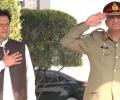
'With the extension issue settled clearly in his favour, Gen Bajwa would be free to fashion a more hardline policy against India. 'We could, therefore, expect a raising of the ante in Kashmir,' says Rana Banerji.
The already tense relations between the United States and Pakistan further deteriorated when Admiral Mike Mullen on Thursday accused the Inter-Services Intelligence agency for supporting the Haqqani network in planning and executing an assault on the US embassy in Afghanistan.
Washington and Islamabad are looking more like enemies than allies in a war, thus threatening the US-led war on terror, says Amir Mir
The Pakistan government has rejected former defence secretary Lieutenant General (retired) Khalid Naeem Lodhi's claim that he was sacked on charges of misconduct without being given a hearing, saying he had been fired in the "national interest".
The top United States commander in Afghanistan has said that they are facing difficulties in their latest military campaign against the Taliban due to lack of cooperation from Pakistan.General Stanley McChrystal, the commander of the International Security Assistance Force and US Forces in Afghanistan, is believed to have pursued this line in his secret visit to Islamabad over the weekend, during which he met President Asif Ali Zardari and Army chief Gen Ashfaq Parvez Kayani.
United States special envoy Marc Grossman on Thursday met Pakistan's top civil and military leadership as part of efforts to salvage bilateral relations following the covert American operation in Abbottabad that killed Osama bin Laden.
